Structured cabling — the network infrastructure inside an office, data centre, or modern residential property — is hidden infrastructure. By the time anyone notices it's not working, the installation is closed up and the equipment that depends on it has been deployed.
Testing is the only thing that catches a failure before it becomes a problem. And testing only works if it's done properly — which means individually, per run.
What testing covers.
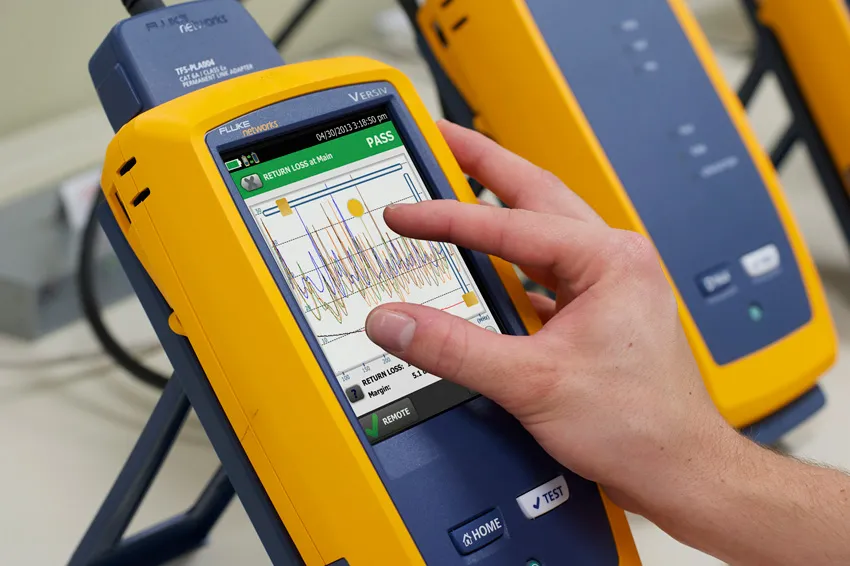
Each Cat6, Cat6A, Cat7, Cat8, or fibre cable installed in a structured cabling system has a performance specification it must meet. The specification is defined by the cable's category and is verified by a calibrated tester that checks several parameters along the run.
A passing test confirms the cable will support the data rates it's rated for. A failing test means the cable, the connectors, the termination, or the routing is going to cause problems — and that the problem will appear under load, not at rest.
Sampling vs full testing.
There's a long-standing temptation in cabling installations to sample. Test 10% of the runs, or 25%, and infer from the results that the rest are fine. This is faster on site and produces a cleaner-looking handover document with fewer test reports.
It also misses faults. Cabling failures aren't evenly distributed across an installation — they cluster around specific terminations, specific cable batches, or specific routing decisions. A 10% sample that happens to land on a clean section will pass while the failures sit untested elsewhere.
Approach | What it produces |
|---|---|
Sampling | Tests a percentage of installed runs. Faster on site. Cheaper to deliver. Misses clustered or termination-specific faults. |
Full Testing | Tests every run individually. Slower on site. More expensive. Catches every fault before commissioning. |
A 10% sample tests 10% of the cables and zero of the problems.
Why faults cluster.
Structured cabling faults don't appear randomly. There are usually reasons:
A specific installer terminated a section of the work and produced inconsistent results.
A specific cable reel had a manufacturing defect affecting all the runs pulled from it.
A specific containment route caused damage during installation.
A specific patch panel was poorly punched down.
In every case, the faults are concentrated. Sampling can miss the entire affected section if the sample doesn't land on it. Full testing finds the cluster.
What a proper test report contains.
A formal cabling test report should include data per run — not summary data, not pass/fail flags, but the recorded values for each cable. This allows the report to be audited later if a particular run develops a fault, and confirms the work was tested individually rather than sampled.
The report should also be tied to a patch schedule that identifies each cable by reference, so a test result can be matched to a specific port and end location. Without that, the test data is unfindable when something goes wrong.
When sampling is acceptable.
Sampling has a place — but not in primary handover testing. Where sampling can be appropriate:
Diagnosing a suspected widespread fault, where finding any failure confirms the diagnosis.
Periodic re-testing of an existing installation that was originally tested in full.
Verifying a small modification or addition to an installation.
None of these are equivalent to handover testing of new structured cabling. For new installations, full testing is the only approach that produces a defensible record of the work.
HOW BLS ELECTRICAL HANDLES CABLING TESTING
Every cable run installed by BLS Electrical is tested individually against its category specification. Test data is recorded per run and compiled into a formal report tied to the patch schedule. No sampling. No aggregated pass/fail results — recorded values, per cable, per port.
If you're planning a structured cabling installation, or you've inherited an installation where the original testing was incomplete, get in touch.
Get In Touch
Submit Your Inquiry
Submit the form and we will get in touch with you shortly
